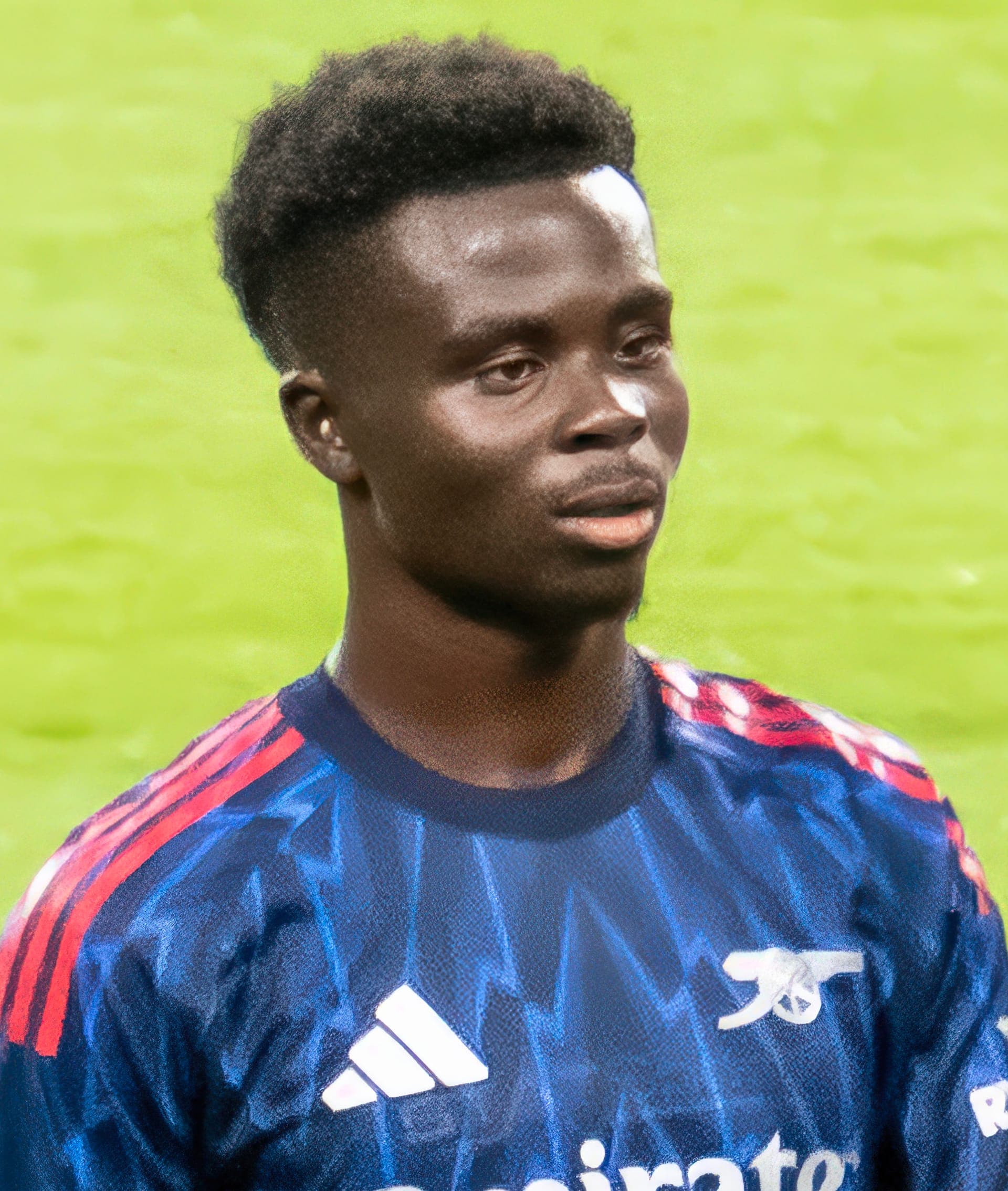
Bukayo Saka's Quiet Tournament Is Exactly What England Needed
No goals yet, no headlines — and no problem. England's right winger has spent the 2026 World Cup doing the unglamorous work that makes a 10-goal, 3-conceded team function.
England have scored ten goals and conceded three through four matches at this World Cup, won their group, survived a knockout scare against DR Congo, and set up a round-of-16 tie with Mexico at the Estadio Azteca. Harry Kane has five of the goals and the Golden Boot chatter; Jude Bellingham has two and the tactical think-pieces. Bukayo Saka has none — and any conclusion drawn from that number would misread how this England team works.
The job without the numbers
Saka's tournament has been a study in what wingers contribute when the scoresheet ignores them. England's attacking structure under Thomas Tuchel loads the central lane: Kane dropping, Bellingham arriving, the midfield feeding both. For that geometry to function, someone has to hold the width on the right and pin the opposing left-back — stay high, stay wide, threaten the run in behind often enough that the defense cannot squeeze the middle. That someone is Saka.
The opening 4-2 win over Croatia was the template. England's four goals came through the center — Kane twice, Bellingham, then Marcus Rashford from the other flank — but the space they arrived into existed because Croatia's back line was stretched across the full width of the pitch. Against Panama, in the 2-0 win that closed the group, the same pattern: Saka's positioning dragging defenders away from the zones Kane and Bellingham scored from. Only the 0-0 against Ghana resisted, a night when England's width produced crosses without takers and the game died in the final third.
None of this is new to anyone who watches him weekly. At Arsenal, Saka has spent half a decade as the reference point of the attack — the man who receives under pressure, draws the double-team and still produces. He passed 50 career goals for the club while still in his early twenties, has been Arsenal's Player of the Season multiple times, and was the PFA Young Player of the Year for 2022-23. The consistency is the achievement: since breaking into the side as a 17-year-old in 2018, he has barely missed a stretch of games that mattered, one significant hamstring injury aside.
Forged by the worst night
No profile of Saka at a major tournament can skip the formative event. At Euro 2020, aged 19, he stepped up fifth in the final's penalty shootout at Wembley with everything riding on it, and Gianluigi Donnarumma saved. The racist abuse that followed became a national reckoning; Saka's response — a statement of defiance, then years of relentlessly excellent football — became one of modern English sport's better redemption stories. By Euro 2024 he was England's best attacker in stretches of the run to the final, scoring in the quarter-final shootout against Switzerland with a penalty of total conviction.
That arc matters for this World Cup because knockout football has a way of returning to the same players. If England's tie with Mexico, or anything after it, reaches penalties, Saka will take one. Nobody who has followed the last five years doubts it.
Why Mexico changes his assignment
The Azteca on July 5 presents a specific tactical problem that may finally pull Saka into the headlines. Mexico won Group A without conceding — 2-0, 1-0, 3-0 — and beat Ecuador 2-0 in the round of 32; theirs is a narrow, disciplined defensive block that concedes the flanks and trusts the crowd and the altitude to make crossing teams tired and impatient. Teams like that are broken one of two ways: a set piece, or a wide player who beats his man and creates the overload the block cannot cover.
That second route is Saka's specialty. His one-v-one numbers at Arsenal have been among the best in the Premier League for years, and England's staff will see the Mexican left side as the tie's pressure point. Expect England to overload his flank — full-back underlapping, Bellingham drifting right — precisely because Mexico's structure dares them to.
There is also the fatigue calculus. At 7,300 feet, wide players who press and sprint suffer first. Saka's engine — he presses as diligently as any elite winger in Europe — becomes both weapon and risk, and Tuchel's substitution timing on the right wing may quietly decide the game.
The bigger picture
Saka is 24, at what should be the front edge of his peak, with an England career that already spans a European Championship final, a World Cup quarter-final in Qatar — where he scored three goals in the tournament — and another Euros final in 2024. What is missing, for him as for the entire generation, is the last step. Finals lost on penalties, quarter-finals lost to France: England's recent history is a catalogue of nearly.
A quiet group stage means nothing against that backdrop. Tournament football is sequenced so that the games get bigger as the wingers get more decisive, and England's route from here — hosts Mexico, then likely one of the tournament heavyweights — will demand exactly the things Saka does best. The scoresheet has ignored him for four matches. It rarely ignores him for seven. Sources: FIFA's official match records; career background via Arsenal FC and BBC Sport.