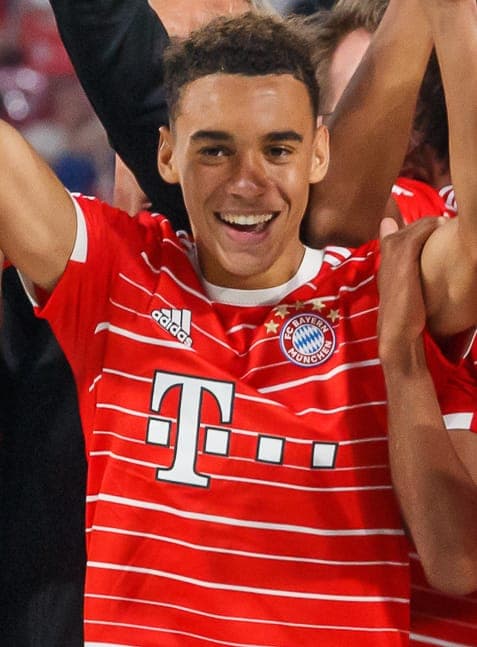
Jamal Musiala Came Back From the Worst Injury of His Life — Then Germany's World Cup Betrayed Him
A year after the horrific ankle injury that ended his Club World Cup, Musiala returned to score at the 2026 World Cup — only for Germany to fall to Paraguay on penalties. A career built on grace keeps colliding with bad luck.
There is a cruel symmetry to Jamal Musiala's last two summers. In July 2025, at the Club World Cup in the United States, he suffered the injury of his career — a fractured fibula and dislocated ankle in a collision with Gianluigi Donnarumma that ended Bayern Munich's tournament and, for a night, made the football world hold its breath. In June 2026, back in the United States, fully recovered and scoring again, he watched Germany's World Cup end in a penalty shootout against Paraguay before the tournament had properly begun. Two American summers; two endings he did not choose.
The boy from Stuttgart, via Southampton
Musiala's origin story remains one of modern football's most charming accidents of geography. Born in Stuttgart to a German mother and British-Nigerian father, raised in England from age seven, he came through Southampton's and then Chelsea's academies, played for England's youth teams alongside Jude Bellingham, and was — by the testimony of every coach who had him — the most naturally gifted ball-carrier of his age group. Bayern Munich extracted him from Chelsea at 16 in 2019, and the decision that followed defined two national teams: in 2021, after long courtship from both federations, Musiala chose Germany.
The years since vindicated everything. He was Bayern's best player in stretches of four Bundesliga title seasons, the joint top scorer at Euro 2024 — three goals in Germany's home tournament — and the half of Nagelsmann's double-ten (with Florian Wirtz) who provides the dribbling: the slalom runs through traffic that earned him the nickname "Bambi" from teammates, all knees and improbable balance.
The injury, and the comeback
The Donnarumma collision in July 2025 was the kind that changes careers. A fractured fibula and ankle dislocation is a footballer's nightmare injury — the recovery consumed the first half of Bayern's 2025-26 season, and the questions that attend it (Does the acceleration return? Does the fearlessness?) hung over his rehabilitation for months. Bayern managed the comeback conservatively; Germany's medical staff coordinated with an eye on exactly this tournament.
The early evidence in America was reassuring. In Germany's 7-1 opening demolition of Curaçao, Musiala scored two minutes into the second half — the first World Cup goal of his career. His movement across the group stage looked, to the eye, undiminished. Whatever else Germany's campaign was, the Musiala comeback subplot was a success.
Then, Paraguay
Germany won Group E despite the stumble of a 2-1 defeat to Ecuador in the closer, and drew Paraguay in the round of 32 — on paper, the most forgiving assignment available. What followed in Foxborough was 120 minutes of the oldest story in knockout football: Julio Enciso's strike shortly before half-time, Kai Havertz's equalizer nine minutes after it, and then a massed Paraguayan defense absorbing everything Germany's expensively assembled attack could design. The shootout went to 4-3; Germany went home; and a country that once treated penalties as a national inheritance had lost a World Cup shootout for the first time.
For Musiala the elimination stings on two clocks. The immediate one is obvious — a tournament that promised redemption delivered three and a half games. The longer one is generational: he is 23, and the core of this German side (Wirtz 23, Musiala 23, the young full-backs) was assembled with 2026 as its arrival announcement. Instead, the announcement is postponed to 2030 at the earliest, and German football spends another cycle in institutional self-examination — a third consecutive World Cup without so much as a quarter-final.
What the tournament showed anyway
Strip the result away and the fifteen days still answered the only question specific to Musiala: the injury did not take his game. The burst that separates him from defenders survived the fibula; the willingness to take contact in the box survived the trauma of the worst contact of his life. Those were not givens. Athletes return from that injury changed more often than press releases admit, and Musiala returned recognizably himself, at the highest level of competition the sport stages.
His club situation compounds the optimism. At Bayern he remains the centerpiece of the post-Müller era, under contract long-term, in an attack built around his half-space work. The Ballon d'Or-adjacent seasons that seemed inevitable before July 2025 remain available; great careers routinely absorb one catastrophic injury, provided it comes early and heals clean. His did both.
The unfair summary
Musiala's World Cup line will read: one goal, eliminated in the round of 32. Lines like that flatten everything true underneath — the year of rehabilitation, the return at full speed, the fact that Germany's failure was structural and collective rather than individual. He leaves America having proven the only thing 2026 could still prove about him, and owed something by the sport that keeps scheduling his setbacks in July. The 2030 World Cup will find him at 27, in his prime, presumably central to whatever Germany rebuilds. It is not consolation. It is, at least, arithmetic. Sources: FIFA's official match records; injury background via ESPN and Bayern Munich.